
Bhimbetka: Painting with the Earth
Of all the places where Indian art begins, none has held my imagination quite like Bhimbetka. Long before paper or canvas, hunter-gatherers on these sandstone hills in the foothills of the Vindhyas turned rock walls into a record of their world: bison and deer in mid-stride, dancers linked arm in arm, honey-gatherers scaling trees. Some images may be around 10,000 years old, and the tradition continued, layer upon layer, into historical times (Misra, n.d.; UNESCO, 2003).
As a painter, what moves me most is the ingenuity. Every colour on these walls came from minerals, the brushes came from the surrounding forest, and much of the work has survived millennia of monsoons. Drawing on Yashodhar Mathpal’s landmark study, Prehistoric Rock Paintings of Bhimbetka, Central India (1984), and later scientific work, this post looks at how these paintings were made, and why.
A hill of painted shelters
Bhimbetka lies about 45 km south of Bhopal in Madhya Pradesh (Misra, n.d.). Though often called “caves”, the sites are rock shelters within massive sandstone outcrops (UNESCO, 2003). V. S. Wakankar discovered the site in 1957, and in 2003 it became a UNESCO World Heritage Site with around 400 painted shelters in five clusters (ICOMOS, 2003; Misra, n.d.; UNESCO, 2003).
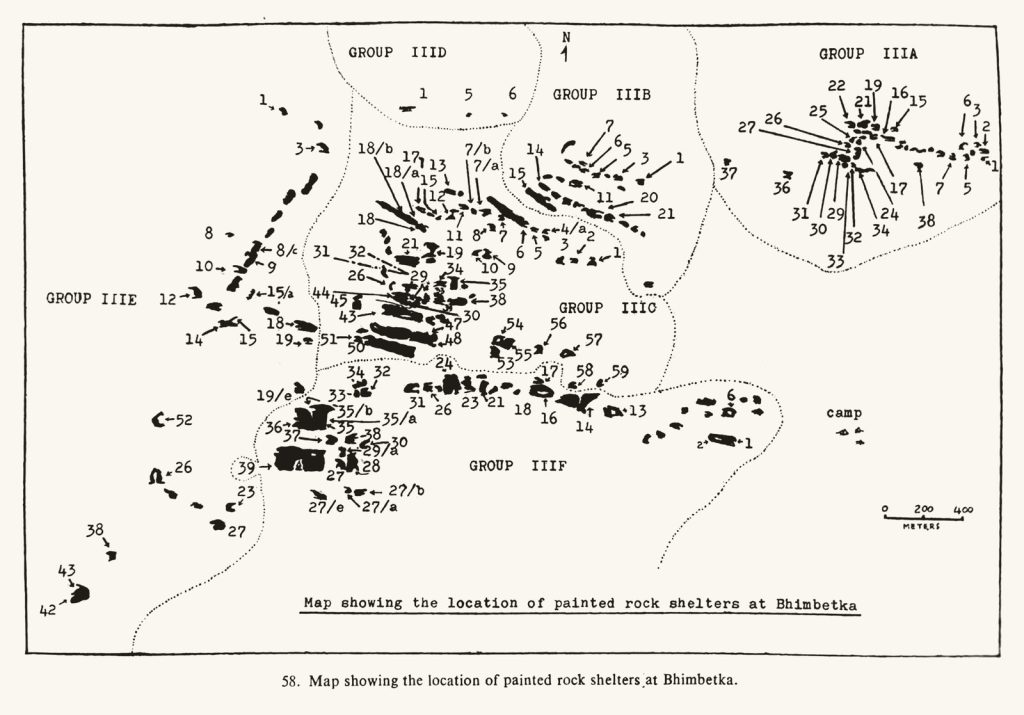
The first exhaustive study came from Yashodhar Mathpal, who surveyed the paintings for his doctorate at Poona University (Misra, n.d.). Of 243 shelters in his study area, 133 held paintings (Dubey-Pathak, 2014), and he recorded 6,214 painted figures (Mathpal, 1984, p. 185): over 2,300 humans, 1,377 animals from about 29 species, and 584 abstract patterns (Dubey-Pathak, 2014). His map, below, numbers each painted shelter within groups IIIA to IIIF.
The seat of Bhima
The name itself carries a story: Bhimbetka is a corrupted form of the Hindi Bhimbaithka, “sitting place of Bhima”, the mighty Pandava of the Mahabharata (Mathpal, 1984, p. 28; MP Tourism, n.d.). Bhima is a hero or deity to several tribes of these hills and forests, who probably named the hill because its colossal rocks seemed a fitting seat for a man famed for his strength (Mathpal, 1984, p. 28).
The epic echoes across the landscape. The nearest village, Bhiyanpur, about two kilometres away (Misra, n.d.), takes its name from Bhimapura, the village of Bhima. At its southwestern end is Ban Ganga, a spring said to have been made by an arrow; it is believed to be the spring Arjuna created to quench the thirst of the ailing Bhishma. To the southeast, a spring and ruins are called Pandapur, the village of the Pandavas (Mathpal, 1984, p. 28). In the epic itself, Arjuna pierces the earth with an arrow beside Bhishma, lying on his bed of arrows, and water rises for him (Ganguli, 1883–1896, Section CXXIII).
Mathpal notes that nothing in the Mahabharata or Puranic writings links Bhimbetka to the epic, so these are local traditions rather than history (p. 28). Yet the area stayed sacred long after its first painters, with probable Buddhist stupas on neighbouring Bhonrawali hill, Asokan Brahmi inscriptions on both hills, and ruined Paramara-period temples near Ban Ganga with images of Shiva and Nandi (ICOMOS, 2003; Mathpal, 1984, p. 28).
Technique: brushes, washes and layers
Mathpal describes four techniques in Indian rock painting: wet transparent colour, wet opaque colour, dry crayon and stencil. He likens the first two to watercolour and to oil or tempera, and any student in our studios would recognise them. All but stencil were used at Bhimbetka: of his 6,214 figures, 53% are in transparent colour greatly diluted with water, 45% in opaque colour and under 1% in crayon (Mathpal, 1984, p. 185).
No brushes survive, but the paintings are evidence in themselves. Mathpal argues that the tiny figures of phase B and the decorated animals of later phases needed fine, pointed brushes, soft enough to glide over uneven rock and hold plenty of diluted colour. The forest offered fur from animals such as the squirrel, which appears in one painting, cotton from the semal tree and gum from bel and babool. Folk artists in Indian villages, he notes, still use the tulika and vartika, brushes named in early Sanskrit texts (Mathpal, 1984, p. 190).
The painters worked straight onto bare rock, itself a coloured surface: Lower Vindhyan sandstone, milky crimson with bands from dark purple to milky white (Mathpal, 1984, p. 28). They applied no plaster or ground, and high figures were probably painted from scaffolds or tree branches. Later artists painted over earlier figures without erasing them; Mathpal recorded up to 15 layers, though two or three is usual (Mathpal, 1984, p. 197). These superimpositions give archaeologists a relative timeline of styles (Misra, n.d.).
Colour: a palette ground from the earth
Mathpal lists 21 colours at Bhimbetka, from creamy and ashy whites through yellow ochre, raw sienna, vermilion, scarlet and crimson to sepia, purple, emerald green and black (1984, pp. 188–189). White is the most common, used for nearly half the figures (47%), followed by light red, the pure haematite tone (26%). Emerald green appears in just 17 figures, all from phase B, and black in only five (p. 189).
The colours of prehistoric rock painters, Mathpal writes, “were derived from minerals” (p. 187), and at Bhimbetka the shelters hold the evidence:
- Reds came above all from haematite, known in India as geru. Mesolithic layers of shelter IIIF-23 yielded pieces of colour rubbed on several facets, in shades from light red and scarlet to crimson and sepia (Mathpal, 1984, pp. 187–188). Closer to home in Rajasthan, V. N. Misra reported geru from the earliest Mesolithic phase at Bagor (Mathpal, 1984, p. 187).
- Yellow, black and green: Wakankar’s excavation of shelter IIIA-28 produced yellow ochre, manganese and terre verte (green earth) (Mathpal, 1984, p. 187). Raman analysis has since identified goethite, a yellow iron oxide, in the paintings (Ravindran et al., 2013).
- White: deep inside shelter IIIE-14, Mathpal found a slender white limestone stick with several ground facets. Tested on paper, such fragments still produced good colour (p. 188).
How powder became paint is less certain. No palette or paint pot has been found, though large works such as the silhouetted mythical boar in shelter C-19 must have needed a container of prepared colour, perhaps a gourd, hollow bamboo or leaf cup (Mathpal, 1984, p. 189). Chemical tests on Indian rock-painting samples have found no gum, glue, fat or resin, suggesting water was the usual medium, although one Bhimbetka sample showed a possible organic binder (Sharma & Singh, 2022).
Design: twelve ways to draw a figure
Following a scheme first used by Wakankar, Mathpal sorted figures into three approaches, natural (or representational), geometric and abstract, and then by execution: silhouetted in solid colour, decorated with internal patterns, partially filled, or outlined. Three approaches times four treatments give twelve sub-styles, set out in his chart (Dubey-Pathak, 2014; Mathpal, 1984, Fig. 59).
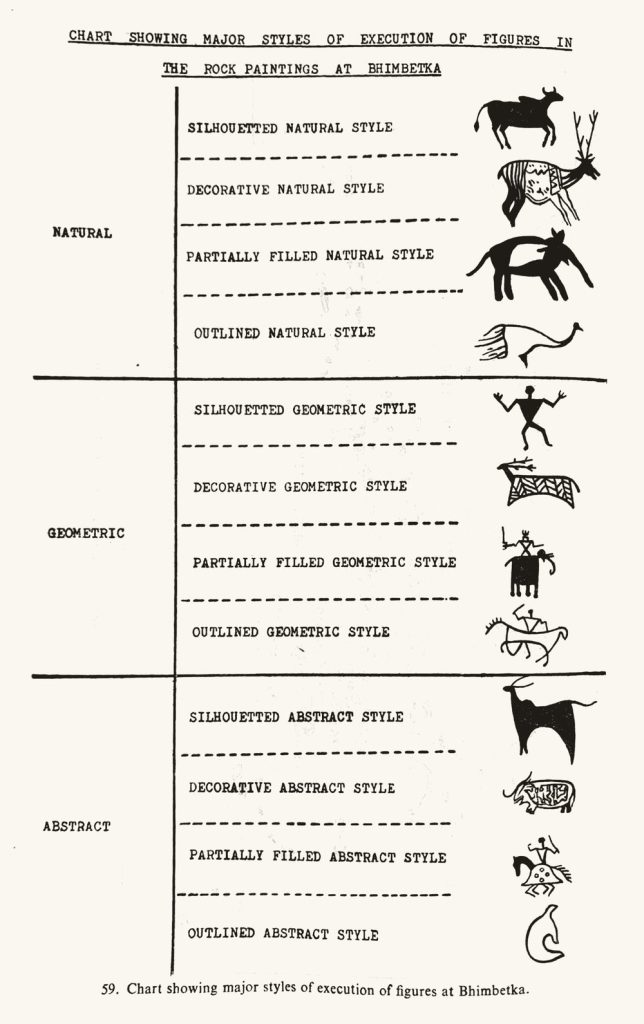
Abstract figures make up about 38% of Mathpal’s images, natural ones 34% and geometric ones 25% (Dubey-Pathak, 2014). Animals are drawn in profile and far more realistically than humans, who often appear as stick figures. In later phases, animal bodies are decorated with lattices and wavy lines (Misra, n.d.).
Standing the test of time
Why have paintings made from ground stone and water outlasted empires? Earth pigments such as haematite are highly stable against light, water and oxidation (Sharma & Singh, 2021). For Indian rock paintings, researchers also suggest that water acting slowly on siliceous rock formed an invisible film of colloidal silica that fixed the pigment, and that in places the pigment soaked deep into the rock (Sharma & Singh, 2022).
Shelter from the weather was not the painters’ priority: exposed rock faces carry several drawings, while some large, well-covered shelters were left almost bare (Mathpal, 1984, p. 197). Weather has taken its toll. Exposed paintings have faded or washed away, others lie under a film of calcium carbonate, and some appear only when the rock is moistened (Misra, n.d.). Because the paintings have not been directly dated, their ages rest on excavation and the order of layers (ICOMOS, 2003; Misra, n.d.).
Why did they paint?
Mathpal himself calls the motivation behind prehistoric rock painting a highly disputed subject (1984, p. 197). No one left a written explanation, but the subjects suggest several overlapping motives.
- About 29 animal species appear (Dubey-Pathak, 2014), from gaur and rhinoceros to sambar and monkeys, drawn with accurate anatomy and real vigour (Misra, n.d.). These are the works of people who watched their world closely.
- Group dances with a drummer, a family huddled over a dead child and, later, processions and battles (Misra, n.d.) read like a community’s shared memory, kept layer upon layer across generations.
- Hunting with barbed, stone-tipped arrows, women trapping small animals, and climbers collecting honey and fruit (Misra, n.d.) record how to live off the forest. Villages around Bhimbetka still share many of these traditions (UNESCO, 2003).
- Mathpal recorded 285 hunter figures, nine of them women (Dubey-Pathak, 2014). Writing about European Palaeolithic art, Mithen (1988) proposed that animal images helped hunters gather and pass on information about animal behaviour.
- Superstition and belief. Mythical creatures, ritual performers and a possible mother goddess appear on the walls (Dubey-Pathak, 2014), and some shelters may have served as shrines for initiating the young into magico-religious beliefs (Misra, n.d.).
- Nearly 600 abstract patterns (Dubey-Pathak, 2014) and the decorative sub-styles show real pleasure in pattern. Yet the most heavily painted shelters show little sign of habitation, so the aim was not simply to beautify homes; some works may express the creative urge of gifted individuals (Misra, n.d.).
Conclusion: India's first archive
Bhimbetka shows that ingenuity did not wait for metal tools or writing. With minerals rubbed on stone, water, and brushes of fur, fibre and twig, its painters built a durable visual language and refined it over thousands of years. For those of us who teach drawing and painting in Jaipur, it is a humbling reminder that the fundamentals of our craft, looking closely, preparing colour and choosing the right mark, are as old as art itself. Whatever their purpose, these walls preserve what mattered to their makers: the animals they studied, the skills they taught, the rituals they shared and the beauty they saw.
Dr. Sarika Kaul, Head, Department of Drawing and Painting
References
- Dubey-Pathak, M. (2014). The rock art of the Bhimbetka area in India. Adoranten, 5–22. Link
- Ganguli, K. M. (Trans.). (1883–1896). The Mahabharata, Book 6: Bhishma Parva (Section CXXIII). Sacred Texts. Link
- (2003). Rock shelters of Bhimbetka (India), No. 925 [Advisory body evaluation]. UNESCO World Heritage Centre. Link
- Mathpal, Y. (1984). Prehistoric rock paintings of Bhimbetka, Central India. Abhinav Publications. Link
- Misra, V. N. (n.d.). The prehistoric rock art of Bhimbetka, Central India. Sahapedia. Link
- Mithen, S. J. (1988). Looking and learning: Upper Palaeolithic art and information gathering. World Archaeology, 19(3), 297–327. https://doi.org/10.1080/00438243.1988.9980043
- MP Tourism. (n.d.). Rock shelters of Bhimbetka. Link
- Ravindran, T. R., Arora, A. K., Singh, M., & Ota, S. B. (2013). On- and off-site Raman study of rock-shelter paintings at world-heritage site of Bhimbetka. Journal of Raman Spectroscopy, 44(1), 108–113. https://doi.org/10.1002/jrs.4148
- Sharma, A., & Singh, M. R. (2021). A review on historical earth pigments used in India’s wall paintings. Heritage, 4(3), 1970–1994. https://doi.org/10.3390/heritage4030112
- Sharma, A., & Singh, M. R. (2022). A review on rock paintings of India: Technique, pigment and conservation. Indian Journal of History of Science, 57(4), 317–329. https://doi.org/10.1007/s43539-022-00060-2
- UNESCO World Heritage Centre. (2003). Rock shelters of Bhimbetka. Link
Image credits: Figures 1 and 2 are reproduced from Mathpal, Y. (1984), Prehistoric Rock Paintings of Bhimbetka, Central India, Abhinav Publications, Figs. 58 and 59, for educational purposes. Copyright remains with the author and publisher.